

Introduction
Automation is no longer a feature reserved only for the most advanced projects. Today, in both residential and commercial spaces, more and more users are looking for solutions that improve comfort, efficiency, and everyday control. In this context, the roller shutter motor has become a key component.
But what exactly is a roller shutter motor, and why is it so important? In simple terms, it is a system that allows a roller shutter to open and close automatically, without the need to operate a strap or crank manually. This not only improves ease of use, but also adds value in terms of functionality, security, and modernization of the space.
In this guide, we explain what a roller shutter motor is, how it works, what types are available, and what factors you should consider when choosing the most suitable option for your project.

What Is a Roller Shutter Motor? Beyond Simple Automation
A roller shutter motor is an electro-mechanical drive unit engineered to automate the rotation of the shutter shaft (barrel). While its primary job is to lift and lower the curtain, a modern motor serves as the "brain" of your physical security barrier.
In high-performance environments, the importance of a precision-engineered motor goes far beyond convenience:
- Load Distribution: It ensures the weight of the curtain is lifted evenly, preventing slat misalignment.
- Operational Longevity: Unlike manual operation, which is often jerky and forceful, a motor provides a smooth, constant torque that reduces wear and tear on the springs and laths.
- Security Integration: Modern motors feature self-locking mechanisms that make it nearly impossible for intruders to manually lever the shutter open from the outside.
Manual vs. Motorized Roller Shutters: The Real-World Impact
The shift from manual to motorized systems isn't just about "pressing a button"—it’s about safety, efficiency, and asset protection.
| Feature | Manual Operation | Motorized Operation |
|---|---|---|
| User Effort | High (Physical strain, especially for industrial doors) | Zero (Automated via switch or remote) |
| Consistency | Variable (Prone to "slamming" and spring damage) | Precision (Soft start/stop, consistent speed) |
| Capacity | Limited by human strength (Lightweight only) | High-Torque (Can lift curtains exceeding 1000kg) |
| Safety Features | Limited to manual locks | Can integrate sensors, safety brakes, and obstacle detection |
| Smart Capability | None | Full integration with BMS, Apps, and Timers |
When Does Motorization Become Essential?
While any door can be motorized, it becomes a critical requirement in several specific scenarios:
1. Handling Large-Scale Industrial Curtains
Once a shutter exceeds a certain height or weight (typically over 25-30kg), manual operation becomes a health and safety risk. High-torque industrial motors are essential for warehouse and loading bay doors.
2. High-Frequency Commercial Use
For retail stores or logistics hubs where doors cycle several times a day, manual operation is inefficient. Electric motors ensure rapid entry and exit without exhausting staff.
3. Advanced Accessibility (ADA Compliance)
In residential and public buildings, motorization is key to improving accessibility for individuals with limited mobility, allowing them to control their environment via voice command or remote.
4. Smart Security & Remote Management
In modern smart homes or commercial developments, motorization allows for "Group Control." You can close 50 shutters simultaneously at the end of a business day or set timers to simulate occupancy while you are away.
The Mechanics of Motion: How a Roller Shutter Motor Works
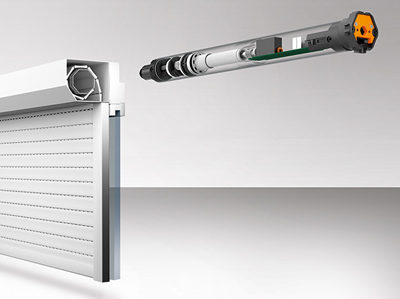
At its core, a roller shutter motor converts electrical energy into mechanical torque. The motor is typically a tubular design, engineered to fit precisely inside the shutter’s octagonal or round axle (the shaft).
When activated via a switch, remote, or smart hub, the motor rotates the internal drive wheel, which in turn rotates the shaft. This motion either winds the curtain slats around the barrel to open or unfurls them to close.
Precision Control: The Role of Limit Switches
A critical feature of any professional motor is the Limit Switch system. These internal sensors define the exact "Stop" points for the curtain.
- Mechanical Limits: Adjusted manually using a wand or screw on the motor head.
- Electronic Limits: Programmed via remote control, offering higher precision and "obstacle detection" to stop the motor if something is blocking the door.
Anatomy of a Motorized Shutter System
To ensure long-term reliability, the motor must work in harmony with several key hardware components:
- The Drive Motor: The power plant of the system.
- The Octagonal/Round Shaft: The "spine" that supports the curtain weight.
- Adapters & Crowns: Specialized rings that match the motor's diameter to the internal shape of the shaft.
- Security Rigid Links: Connect the curtain to the shaft and provide "anti-lift" protection when the motor is closed.
- Safety Brake (Anti-Drop): An essential mechanical fail-safe (required for heavy or commercial doors) that locks the shaft if the motor or spring fails.
Engineering the Right Fit: Shaft Diameter & Newton Meters (Nm)
Choosing a motor isn't just about brand; it's about physics. The two most critical specifications are Shaft Diameter and Torque (Nm).
1. Shaft Compatibility
The motor must fit snugly inside the shaft to prevent vibration and gear stripping.
- 40mm Shafts: Typically used for lightweight PVC or aluminum window shutters (Residential).
- 60mm/70mm Shafts: The standard for most domestic garage doors and shop fronts.
- 94mm+ Shafts: Reserved for heavy-duty industrial outboard motors.
2. Understanding Torque (Nm)
Motor power is measured in Newton Meters (Nm). Choosing the wrong torque leads to premature motor burnout or dangerous strain:
- Too Low: The motor will struggle to lift the curtain, overheat, and eventually fail.
- Too High: The motor may exert too much force, potentially damaging the slats or safety sensors if the door hits an obstruction.
Pro Tip: Always calculate the "Total Weight" (Slat weight + Friction) before selecting your Nm rating. A 20Nm motor can typically lift around 35-40kg on a 60mm shaft.
Modern Control Ecosystems
The "Smart Revolution" has transformed how we interact with rolling doors. Today, users can choose from four primary control tiers:
- Hardwired Wall Switch: The most reliable, "no-frills" solution for commercial warehouses.
- Radio Control (RTS/Bi-Directional): Allows for remote operation without line-of-sight; bi-directional motors can even send "Status Alerts" to your phone (e.g., "Shutter is 50% open").
- Wi-Fi & App Integration: Control your security from anywhere in the world via smartphone.
- Automated Sensors: Integrate with Sun/Wind sensors to automatically lower shutters for energy efficiency or raise them during high winds to prevent damage.
What Types of Roller Shutter Motors Are Available?
When talking about roller shutter motor types, the most useful classification is usually based on the type of installation and the level of control.
Tubular Roller Shutter Motor
The tubular roller shutter motor is the most common option for roller shutters. It is installed inside the shaft and stands out for its discreet integration, efficient performance, and broad compatibility with different types of shutters.
It is a widely used option in both residential and professional projects because it offers a clean installation and a good balance between performance and reliability.
Advantages of the tubular motor:
- Compact integration
- Strong performance
- Neat and discreet solution
- Wide range of options
- Suitable for residential and commercial use

Roller Shutter Motor with Remote Control
A roller shutter motor with remote control includes a remote operation system that allows the shutter to be controlled without using a physical wall switch.
This option is especially useful in renovation projects or installations where greater comfort is desired without making the work too complex. It is also a practical solution when several shutters need to be controlled from a single remote.
Main advantages:
- Greater comfort
- Less dependence on control wiring
- Ability to manage multiple shutters
- Good solution for modernizing existing installations
Wi-Fi Roller Shutter Motor
A Wi-Fi roller shutter motor allows the shutter to be controlled through a mobile app or a connected smart network. This option is increasingly popular among users who want a higher level of automation.
Thanks to this system, the shutter can be scheduled by time, operated remotely, and integrated into other routines within the home or building.
Smart Roller Shutter Motor
A smart roller shutter motor goes one step further. In addition to remote control, it can be integrated with voice assistants and smart home ecosystems.
It is ideal for those who want a more advanced and connected experience, especially in smart homes or projects with a clearly technological approach.
Compatibility with Alexa and Google Home
Within this category, many people specifically look for solutions such as:
- roller shutter motor compatible with Alexa
- roller shutter motor compatible with Google Home
These options allow the shutter to be managed through voice commands or integrated automations with other devices.
Standard Electric Roller Shutter Motor
There are also simpler electric roller shutter motor solutions designed to automate the shutter without necessarily including advanced connectivity features.
This type of motor is suitable when the priority is functionality, reliability, and a controlled budget.
Master Selection Guide: Comparing Roller Shutter Motor Technologies
Selecting the right motor is a balance between lifting capacity (Torque) and operational intelligence. The table below breaks down the most common configurations in today's market:
| Motor Type | Best Application | Control Tier | Primary Advantage | Technical Consideration |
|---|---|---|---|---|
| Standard Tubular | Residential Windows & Shop Fronts | Basic (Hardwired) | Cost-effective; extremely reliable. | Requires physical wiring to a wall switch. |
| Radio-Controlled (RF) | Retrofits & High-Comfort Homes | Advanced (Wireless) | No wall chasing needed; clean finish. | Signal range and potential interference. |
| Smart Wi-Fi Motor | Modern Smart Homes | Ultra-High (App) | Remote scheduling and voice control. | Depends on stable 2.4GHz Wi-Fi coverage. |
| High-Torque Industrial | Warehouses & Loading Bays | Professional | Capable of lifting 500kg+ curtains. | Requires 3-phase power and safety brakes. |
| Solar-Powered Motor | Off-grid or Eco-projects | Medium | Zero energy costs; no wiring. | Battery life and sunlight exposure. |
The Engineering Checklist: 5 Factors for a Perfect Fit
Don't just buy "the most powerful" motor. An oversized motor can damage the curtain slats, while an undersized one will burn out its capacitors within months. Use this technical checklist:
- Total Suspended Weight: Calculate the weight per square meter (e.g., Extruded Aluminum vs. Foam-filled Slat) and add a 20% safety margin for friction.
- Shaft/Axle Diameter: Ensure the Drive & Crown adapters match your 40mm, 60mm, or 70mm octagonal shaft perfectly to avoid "shutter wobble."
- Duty Cycle (Frequency of Use): Standard residential motors have a Thermal Cut-out after 4 minutes of continuous use. For high-traffic commercial areas, specify a motor with a "High Duty Cycle" rating.
- IP Rating: For external installations or coastal environments, ensure the motor head has at least an IP44 rating to protect against moisture and dust ingress.
- Manual Override (Crank System): Always consider a motor with a Manual Override (MO) feature for garage doors or main entry points, allowing operation during a power failure.
Strategic Recommendations by Project Type
1. Residential & Luxury Developments
The focus here is Acoustics and Integration.
- Recommendation: Ultra-quiet Wi-Fi or Bi-Directional motors. These allow homeowners to check if their shutters are closed via an app (feedback loop) and integrate seamlessly with Amazon Alexa or Google Home.
2. Renovation & Retrofit Projects
The goal is Minimal Disruption.
- Recommendation: Radio-controlled (RF) motors. These eliminate the need to cut channels into walls for switches, saving significant labor costs and mess for the end-user.
3. Commercial & B2B (Retail/Warehousing)
The priorities are Reliability and Legal Compliance.
- Recommendation: Hardwired High-Torque motors paired with Mechanical Safety Brakes. In a B2B context, the simplicity of a wall switch often outperforms complex apps, ensuring any staff member can operate the door safely and consistently.
How to Install a Roller Shutter Motor
One of the most common questions is how to install a roller shutter motor or how to add a motor to an existing roller shutter. Although the specific process depends on the model and the installation, the overall procedure usually follows a similar logic.
General Installation Steps
- Check the condition of the shutter and the shaft
- Confirm motor compatibility
- Install brackets and adapters
- Insert the motor into the shaft
- Secure the assembly properly
- Make the electrical connection
- Adjust the limit switches
- Test the full travel and correct settings if necessary
When to Hire a Professional
Although some installations may appear simple, it is advisable to hire a professional when:
- The shutter is heavy or large
- Complex electrical work is required
- A Wi-Fi or smart system is being installed
- The project involves multiple units
- A technically reliable result is needed
Incorrect installation can lead to travel issues, noise, premature wear, or even breakdowns.
Roller Shutter Motor Price and the Real Cost of Motorization
When someone searches for roller shutter motor price or how much it costs to motorize a roller shutter, they often expect a quick figure. However, the real cost depends on several factors.
What Affects the Price?
The price may vary depending on:
- The type of motor
- The required power
- The control system
- Included accessories
- Installation complexity
- The number of shutters to be motorized
- The need for smart home integration
That is why the price of a basic motor is not the same as that of a Wi-Fi roller shutter motor or a remote-controlled roller shutter motor.
How to Evaluate the Investment Properly
Beyond the initial cost, it is important to consider the total value motorization provides:
- Greater daily comfort
- Better user experience
- Less manual effort
- Ability to automate routines
- Improved perception of the space
- Greater appeal in homes or commercial projects
When analyzed from this perspective, the investment is often more than justified.
Common Problems, Breakdowns, and Maintenance
Although a roller shutter motor is designed to operate reliably, issues can arise if the system is not properly sized or installed.
Most Common Problems
Some of the most frequent issues include:
- The motor does not respond
- The shutter goes up but does not go down
- The travel stops too early
- The motor makes excessive noise
- The remote does not synchronize properly
- The shutter loses smooth movement
Most Common Causes
In many cases, the problems are not caused by the motor itself, but by other factors such as:
- Poor installation
- Incorrect limit switch adjustment
- Incompatibility with the shaft
- A motor that is too weak for the actual weight
- Electrical or power supply issues
- Wear of mechanical components
Good Maintenance Practices
To extend the service life of the system, it is advisable to:
- Check operation regularly
- Avoid forcing the shutter if resistance is detected
- Inspect fixings and alignment
- Review remotes, receivers, and power supply
- Correct small issues before they turn into major failures
How to Identify the Best Roller Shutter Motor for Each Situation
The search for the best roller shutter motor is very common, but the reality is that there is no universal answer. The best motor will always be the one that best matches the specific needs of the installation.
For example:
- If you want a simple and reliable solution, a standard tubular motor may be enough
- If comfort is the priority, a roller shutter motor with remote control will be a very attractive option
- If you want scheduling and remote access, a Wi-Fi roller shutter motor will be more suitable
- If you are looking for advanced automation, a smart roller shutter motor will be the ideal choice
- If acoustic comfort matters, it is worth considering a quiet roller shutter motor
The key is to combine compatibility, intended use, and project expectations correctly.
Conclusion
A roller shutter motor is much more than a technical component. It is a solution that improves the functionality, comfort, and value of a roller shutter, both in homes and in commercial or professional projects.
Understanding what a roller shutter motor is, how it works, and what types are available is the first step to making the right choice. From there, the important thing is to analyze the actual characteristics of the installation: the weight, the shaft, the type of control, and the level of automation desired.
If the choice is made correctly, the result will be a more comfortable, more efficient, and better-adapted installation for the user’s needs.
Frequently Asked Questions About Roller Shutter Motors
Q1: What exactly is a roller shutter motor?
A: A roller shutter motor is an electro-mechanical drive unit (typically a tubular motor) that fits inside the shutter's axle. It replaces manual operation (straps, cranks, or springs) with automated rotational force to raise and lower the curtain with precision and safety.
Q2: How does a roller shutter motor work in daily operation?
A: When triggered by a switch or remote, the motor rotates an internal drive wheel that turns the shutter shaft. It uses limit switches to define the exact open and close positions. Modern motors often include thermal protection to prevent overheating and obstacle detection to stop the motor if something is in the way.
Q3: What are the most common types of roller shutter motors available?
A: Depending on the project, you can choose from:
- Tubular Motors: The industry standard for window and shop shutters.
- Radio (RF) Motors: Wireless systems controlled by handheld remotes.
- Smart/Wi-Fi Motors: Integrated systems that connect to apps like Tuya, Alexa, or Google Home.
- Central Motors: Often used for retrofitting high-street shop fronts with existing spring-balanced shafts.
Q4: How do I calculate which roller shutter motor I need?
A: You must determine two main factors:
- Lifting Torque (Nm): Based on the curtain's total weight (Steel is heavier than Aluminum).
-
Adapter Size: Most domestic motors are designed for 40mm or 60mm octagonal shafts, while industrial versions require larger diameters.
Rule of thumb: A 20Nm motor typically handles up to 35-40kg of curtain weight.
Q5: Can you add a motor to an existing manual roller shutter?
A: Yes, this process is known as retrofitting. Most manual shutters can be motorized by replacing the existing shaft or inserting a tubular motor into the current axle. However, you must ensure the side brackets and the structural integrity of the laths can handle the motor’s torque.
Q6: How much does it cost to motorize a roller shutter?
A: Costs vary based on the Newton Meter (Nm) rating, brand, and control method. A basic hardwired motor is the most affordable, while Wi-Fi-enabled or solar-powered systems carry a premium. You should also factor in the cost of a Safety Brake (Anti-drop device), which is legally required for most commercial motorized installations.


