

Gravity is unforgiving. When a roller shutter's counterbalance spring fractures, a 150kg curtain transforms into a lethal falling object in a fraction of a second. Without a Mechanical Safety Brake, there is nothing to arrest this motion before it impacts the ground, vehicles, or personnel.
In the modern industrial landscape, the safety brake is the most vital passive safety component in any rolling door system. It serves as the ultimate fail-safe, mandated by rigorous standards such as BS EN 12604 to ensure workplace safety.
Whether you are a facility manager, a business owner, or an installer, understanding the synergy between springs and brakes is essential for risk mitigation. This article explores the engineering behind anti-drop devices, the physics of spring fatigue, and the maintenance protocols required to stay compliant and protected.
Key Takeaways
- A roller shutter safety brake is a fail-safe mechanical device that prevents the shutter curtain from free-falling if a spring, cable, or motor fails.
- Spring failure is the most common trigger for uncontrolled shutter drops — and it can happen without prior warning.
- EN 12453 and EN 12604 set the regulatory framework for powered industrial door safety in Europe, including requirements for anti-drop protection.
- Safety brakes work through centrifugal or overspeed-detection mechanisms that engage automatically when descent speed exceeds a safe threshold.
- Regular testing and inspection — at minimum annually — is essential to verify that the brake remains functional.
- Fire-rated shutters, high-cycle commercial doors, and any shutter curtain over a certain weight threshold typically have mandatory safety brake requirements.
What Is a Roller Shutter Safety Brake?
A roller shutter safety brake is a mechanical device integrated into the shutter drum or shaft assembly that automatically locks the curtain in place the moment it begins to descend faster than its designed operating speed. It requires no electrical signal, no operator input, and no manual activation. It simply responds to physics.
When everything is functioning normally — motor running, spring balanced, cables intact — the brake remains passive and invisible. The moment something fails and the curtain begins to accelerate downward, the brake engages instantly and holds the load.
This is what makes it fundamentally different from every other safety component in your door system. It does not depend on power. It does not depend on a sensor working correctly. It is a purely mechanical, fail-safe device.

How It Differs from a Standard Motor Brake
Most commercial rolling door motors include an internal electromagnetic brake that holds the door in position when the motor is at rest. This is a holding brake, not a safety brake.
The electromagnetic motor brake only functions when the motor has power and is operating correctly. If the motor fails, the power supply is cut, or — most critically — if the counterbalance spring breaks, the motor brake alone is insufficient to prevent a heavy curtain from descending under its own weight.
A dedicated mechanical safety brake operates entirely independently of the motor and electrical system. It is the last line of defense.
The Risk Nobody Talks About: What Happens When a Spring Fails
The Silent Workhorse: Understanding the Counterbalance System
The counterbalance spring is the most stressed mechanical component in any rolling shutter system. Its primary function is to offset the "dead weight" of the curtain—which can often exceed 300kg. By maintaining constant tension, the spring allows the motor to operate efficiently, managing only a small fraction of the actual load.
However, this constant tension comes at a price. Every open-close cycle subjects the metal to cyclic fatigue, pushing the material closer to its structural limit every single day.
Why Counterbalance Springs Fail Without Warning
Unlike a motor that might become noisy or a guide rail that might bend, torsion and tension springs rarely exhibit visible signs of distress.
- Metal Fatigue: Over thousands of cycles, microscopic cracks form within the steel.
- Environmental Corrosion: In humid or industrial environments, oxidation weakens the spring coils from the inside out.
- The "Snap" Event: Failure is almost always instantaneous. One moment the spring is holding hundreds of kilograms of force; the next, it fractures completely.
Expert Insight: Routine visual inspections often miss internal metal fatigue. A spring that looks "fine" on Monday can snap on Tuesday.
The Free-Fall Scenario: From Gravity to Lethal Kinetic Energy
When a counterbalance spring fails, the equilibrium of the door is destroyed. The motor, designed to move a balanced load, is suddenly overwhelmed by the full dead weight of the steel curtain.
What happens next is a matter of physics:
- Sudden Acceleration: Without the spring’s resistance, gravity takes over. The curtain begins an uncontrolled descent.
- Kinetic Energy Build-up: A 200kg steel shutter dropping from just 2 meters carries enough force to crush heavy machinery, write off vehicles, or cause fatal injuries to personnel walking underneath.
- Secondary Structural Damage: The force of a free-falling door often tears guide rails from the masonry, destroys the drive barrel, and can even compromise the building's lintel or overhead support.
The Fail-Safe: How a Mechanical Safety Brake Saves the Day
This is where the Mechanical Safety Brake (Anti-Drop Device) becomes non-negotiable.
A properly installed safety brake acts as the "seatbelt" of your roller shutter. The moment it detects an abnormal increase in descent speed—the first fraction of a second after a spring or chain fails—it engages a hardened steel locking pawl. This instantly arrests the curtain’s movement, locking it securely in place and preventing the "free-fall" disaster entirely.
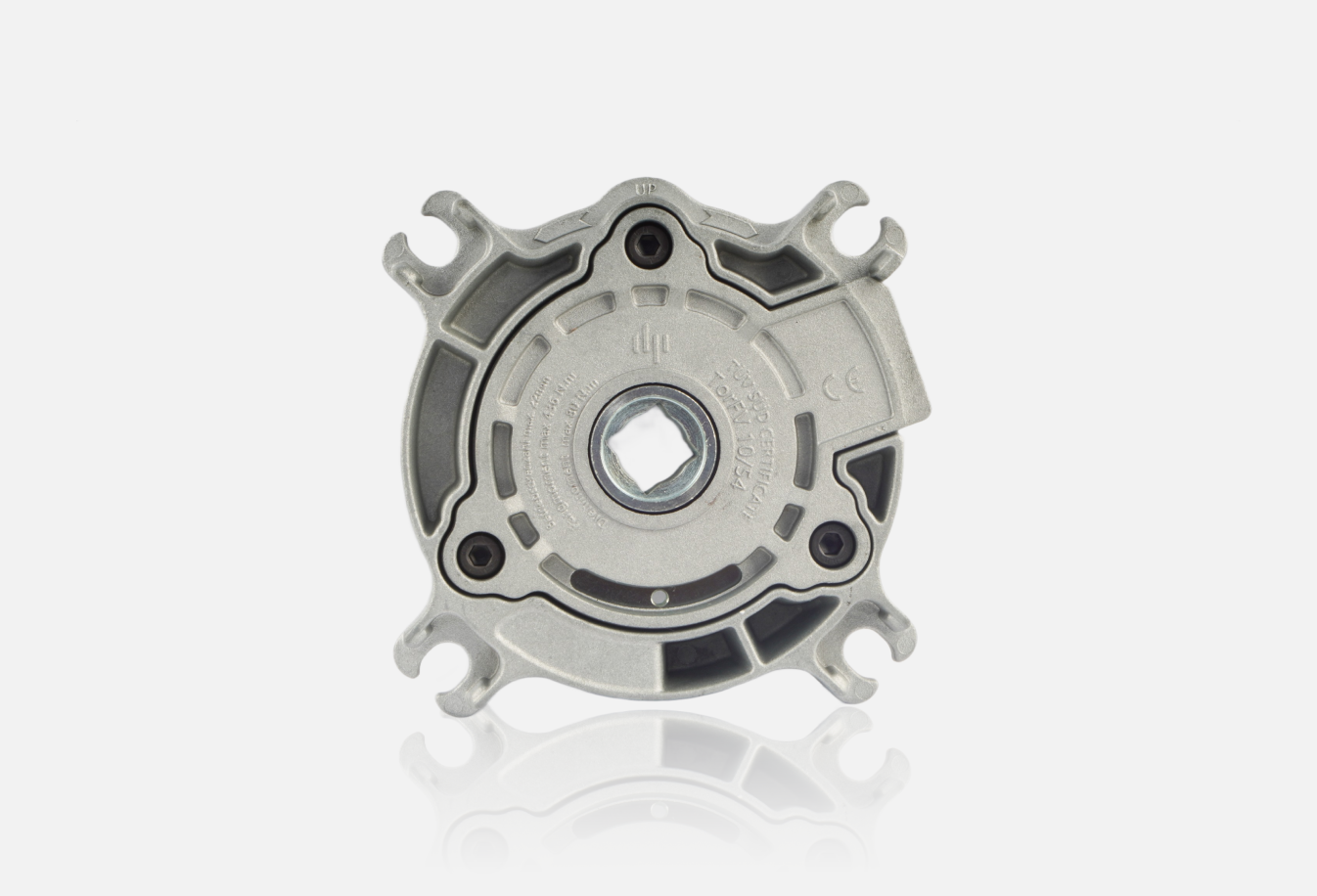
How a Mechanical Safety Brake Works
Most safety brakes used in commercial roller shutter systems operate on one of two principles: centrifugal braking or overspeed detection via a governor device.
Centrifugal Braking Mechanism Explained
A centrifugal safety brake is mounted directly on the shutter shaft or drum. It contains weighted flyweights arranged around a central hub. During normal operation, the curtain descends at a controlled speed and the flyweights remain retracted.
When the descent speed increases beyond the preset threshold — which occurs during a free-fall event — centrifugal force causes the flyweights to pivot outward. They make contact with a braking surface, generating friction that rapidly decelerates and ultimately arrests the curtain's movement.
The entire engagement sequence takes milliseconds. The curtain stops within a very short distance of where the failure occurred.
Overspeed Detection and Automatic Engagement
Some advanced brake systems incorporate a speed governor — a separate device that continuously monitors the rotation speed of the shutter drum. When the governor detects overspeed, it triggers a mechanical locking mechanism that physically prevents further rotation.
Governor-based systems are commonly used on larger, heavier industrial doors where the shutter curtain mass requires a higher-capacity braking force. They can also be integrated with monitoring systems that log events and send alerts to facility management systems.
Both centrifugal and governor-type brakes are designed to be self-resetting or manually resettable after an event, allowing the door to be safely inspected and repaired before returning to service.
Regulatory Standards You Need to Know
If your commercial property is in Europe or a market that references European standards, two documents define the baseline requirements for powered industrial door safety.
EN 12453 — Force and Safety Requirements for Powered Doors
EN 12453 covers the safety requirements for the use of power-operated pedestrian and industrial doors and gates. It establishes maximum permissible forces in the event of door movement — both during normal operation and in failure conditions. Where a door poses a risk of uncontrolled descent, the standard requires that measures be taken to prevent such movement. In practice, for rolling shutters above certain size and weight thresholds, a mechanical safety brake is the accepted solution.
EN 12604 — Mechanical Aspects of Industrial Doors
EN 12604 addresses the mechanical performance requirements for industrial doors, including requirements for suspension systems, counterbalancing, and failure behavior. It explicitly requires that industrial door systems be designed so that failure of any single component — including the counterbalance spring — does not result in an uncontrolled, dangerous movement. A safety brake directly satisfies this requirement.
Note: Always consult a qualified door safety engineer or your local authority having jurisdiction to confirm the specific compliance requirements applicable to your installation. Regulatory requirements vary by country, application, and door specification.
Which Commercial Doors Require a Safety Brake?
Not every roller shutter installation carries the same risk profile. The following categories represent situations where a mechanical safety brake is either required by standard, strongly recommended by best practice, or both:
- Any rolling shutter over a specified curtain weight — typically above 50 kg net curtain weight, though this threshold varies by standard and application
- High-traffic commercial and industrial doors — warehouses, logistics centers, manufacturing facilities, loading docks
- Fire-rated roller shutters — these must close reliably under emergency conditions; an uncontrolled drop creates its own hazard
- Doors over pedestrian traffic zones — anywhere people regularly pass underneath the door opening
- Doors in public-access buildings — retail, hospitality, healthcare, and similar environments
- Doors on upper-floor or elevated openings — where a falling curtain could drop onto a lower level
If your installation falls into any of these categories and you do not currently have a dedicated mechanical safety brake, a safety assessment should be a priority.
Roller Shutter Safety: Centrifugal Brakes vs. Governor Devices Explained
A Governor device is a more sophisticated, proactive speed monitoring system, often found in heavy industrial environments.
- How it works: It uses a separate governor rope or wheel to constantly monitor the shaft's velocity. Instead of just a mechanical lock, it can trigger a separate, more powerful braking system or cut power to the operator.
- Best for: High-usage industrial doors, heavy steel curtains (>200kg), and high-speed doors where precision is vital.
Comparison Table: At a Glance
| Feature | Centrifugal Safety Brake | Governor Device |
|---|---|---|
| Operating Principle | Flyweights engage on speed increase | Rope/wheel monitors speed, triggers brake |
| Integration | Mounted directly on the shaft/drum | Separate unit connected to the brake |
| Ideal Load Capacity | Light to medium (Up to 200kg) | Heavy industrial (200kg - 1000kg+) |
| Complexity | Simpler, fewer moving parts | Higher complexity, multi-component |
| Reset Mechanism | Often self-resetting after inspection | Usually requires professional manual reset |
| Smart Monitoring | Limited mechanical feedback | Can integrate with BMS (Building Management Systems) |
How to Choose the Right Safety Brake for Your Roller Shutter
Selecting the correct safety brake is not a matter of picking the cheapest available option. The brake must be matched to your specific door system to function correctly when it matters. Key selection criteria include:
1. Curtain weight and dimensions
The brake must be rated to hold the full weight of the curtain at the moment of engagement, including dynamic load from the descent.
2. Shaft or drum diameter
Safety brakes are manufactured for specific shaft diameter ranges. An incompatible brake will not seat correctly and may fail to engage.
3. Operating speed
The activation threshold of the brake must be calibrated above the maximum normal operating speed of the door but below the speed at which damage or injury could occur.
4. Cycle rating
For high-traffic doors, choose a brake rated for the expected number of annual cycles. Commercial-grade brakes are built for significantly higher cycle counts than standard devices.
5. Compatibility with the door operator
If your shutter uses a specific tubular motor or operator system, confirm that the safety brake is compatible and that installation does not compromise the motor warranty or void any existing certifications.
6. Certification and compliance
Always select a brake from a manufacturer that can provide documentation of compliance with EN 12604 or equivalent standards applicable in your market.

Strong Conclusion: Don't Leave It to Chance
A roller shutter safety brake is not a luxury feature. It is the mechanical guarantee that a failure somewhere else in your door system does not become a catastrophe.
The scenarios that brakes are designed to prevent — spring fractures, cable failures, motor malfunctions under load — are not theoretical. They occur in real commercial and industrial environments every year. The consequences of an uncontrolled curtain drop can include serious injuries, significant property damage, costly downtime, and substantial legal liability.
The solution is straightforward. Specify a certified mechanical safety brake matched to your door system. Have it installed by a qualified professional. Test it at commissioning. Inspect it regularly. Document everything.
If you are unsure whether your current rolling shutter installation includes an adequate safety brake — or if you are specifying a new commercial door system and want to ensure it meets EN 12453 and EN 12604 requirements — the team at MFP Automatismos can provide guidance on the right safety brake system for your application.
Do not wait for a spring to break to find out whether your door is safe.
FAQ
Q1: What is a roller shutter safety brake and what does it do?
A roller shutter safety brake is a passive mechanical device mounted on the shutter shaft or drum that automatically prevents the curtain from free-falling if a spring, cable, or motor fails. It requires no electrical power to operate. When the curtain's descent speed exceeds the normal operating threshold, the brake engages mechanically and stops the movement within a very short distance.
Q2: Is a mechanical safety brake required by law for commercial roller shutters?
In Europe, EN 12453 and EN 12604 set out safety requirements for powered industrial doors that effectively mandate anti-drop protection for shutters above certain weight and size thresholds. Many national building codes and insurance requirements also specify safety brake compliance. Whether a brake is strictly mandatory depends on the door type, curtain weight, application, and jurisdiction. A qualified door safety engineer should confirm the requirements for your specific installation.
Q3: How often does a roller shutter safety brake need to be tested?
At minimum, the safety brake should be functionally tested annually as part of a comprehensive door safety inspection. High-cycle commercial doors — those operating more than approximately 20 cycles per day — should be inspected every six months. Any door that has experienced a mechanical failure event should be inspected immediately before returning to service.
Q4: Can I retrofit a safety brake onto an existing roller shutter?
In most cases, yes. Safety brakes can be retrofitted to existing roller shutter systems provided the shaft or drum diameter is compatible with an available brake unit and the installation is carried out by a qualified technician. The key requirement is that the brake be correctly matched to the door's curtain weight and operating speed. A professional assessment should always precede a retrofit installation.
Q5: What is the difference between a safety brake and the motor brake on my roller shutter?
The motor brake (electromagnetic brake) is an internal component of the door operator that holds the door stationary when the motor is not running. It depends on electrical power and the motor functioning correctly. A mechanical safety brake is an entirely separate device that operates independently of the motor and power supply. It is specifically designed to activate during failure events — exactly when the motor brake cannot be relied upon.
Q6: Does a fire-rated roller shutter also need a safety brake?
Yes. Fire-rated roller shutters must close reliably under emergency conditions, but an uncontrolled free-fall drop creates its own serious hazard — both to people in the opening and to the structural integrity of the door system itself. A safety brake ensures that even in a failure scenario, the curtain descends in a controlled manner. Most fire shutter standards and associated building regulations require anti-drop protection as part of a compliant installation.


