
Choosing between a single phase and a three phase industrial door motor is not just an electrical question. It affects starting torque, cycle life, heat build-up, control quality, installation complexity, and long-term reliability.
The short answer: for most heavy-duty, high-cycle industrial doors, three phase motors are usually the better choice because they deliver smoother torque, better efficiency, and stronger performance under frequent starts and stops. Single phase motors are often the practical choice when the site only has single phase power, the door is lighter, or the cycle frequency is low.
In other words, the “better” motor depends on the door, the duty cycle, and the power supply available on site.
Key Takeaways
- Single phase motors are simpler to supply and install where three phase power is unavailable.
- Three phase motors are generally stronger, smoother, and better suited to heavy-duty industrial door operation.
- The most important selection factors are starting torque, duty cycle, heat management, and available power supply.
- For frequent operation and heavy doors, three phase usually wins on performance and longevity.
- For smaller doors or low-cycle applications, single phase can be the more economical and practical option.
What Is a Single Phase Industrial Door Motor?
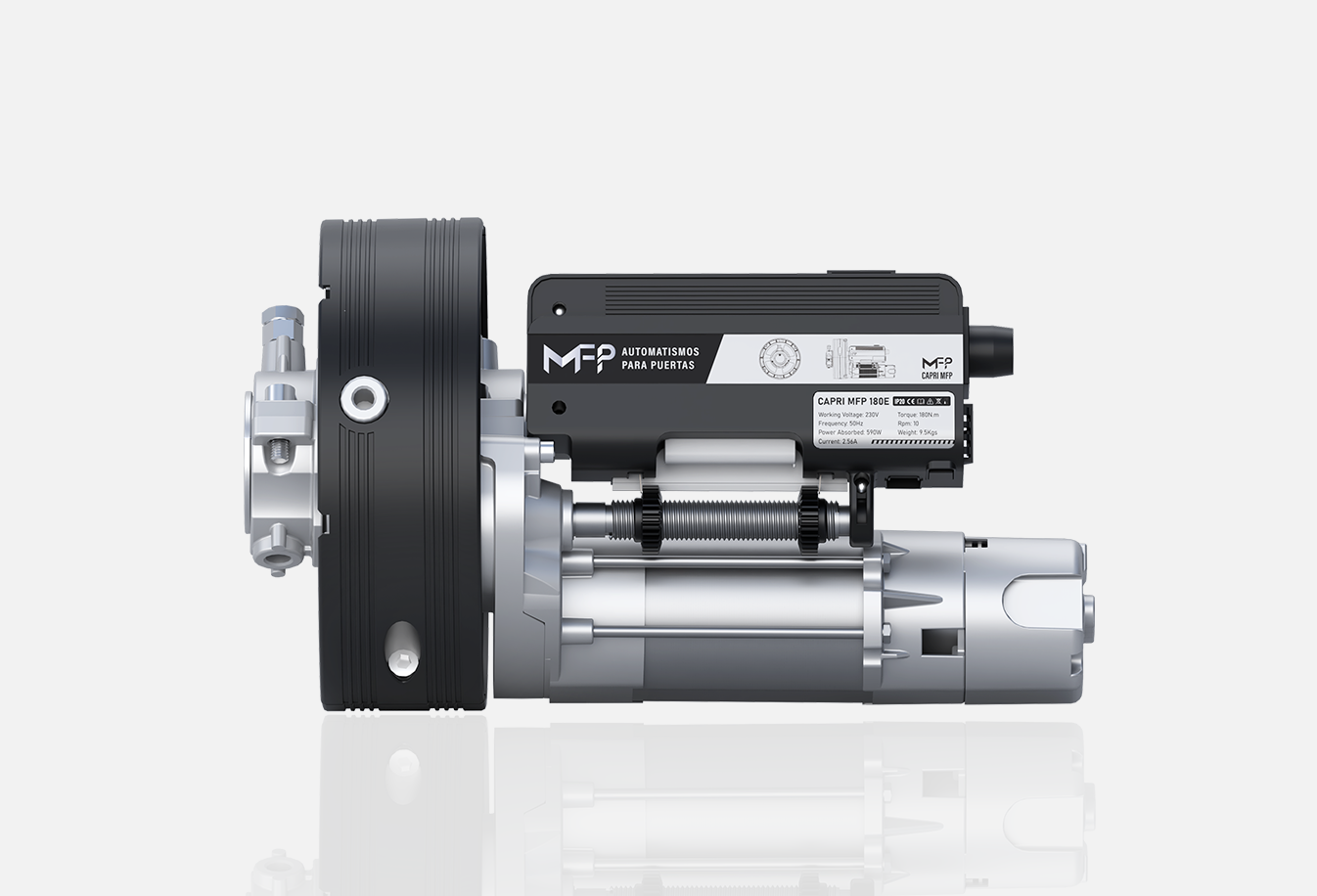
A single phase motor runs from a single AC supply, typically the kind of power available in many light commercial and residential buildings. In industrial door automation, single phase motors are commonly used where three phase infrastructure is not available or not justified.
How a Single Phase Motor Works
A single phase induction motor needs a method to create a starting field, because a single phase supply does not naturally produce a rotating magnetic field at startup. That is why many single phase motors use:
- Capacitor start
-
Capacitor run
This design helps the motor develop starting torque, but the motor is still usually less smooth and less robust under high-load, high-cycle conditions than a comparable three phase motor.
Where Single Phase Door Motors Make Sense
Single phase industrial door motors are a sensible choice when:
- The site has only single phase power
- The door is relatively light
- The opening frequency is low to moderate
- Installation simplicity matters more than maximum performance
- The budget must stay controlled
A single phase motor can be a practical solution for smaller sectional doors, light roll-up doors, and lower-traffic access points.
What Is a Three Phase Industrial Door Motor?
A three phase motor uses a three phase AC supply, usually available in industrial and larger commercial facilities. This type of motor is the standard choice for many heavy-duty door automation systems.
How a Three Phase Motor Works
A three phase supply naturally creates a rotating magnetic field. That gives the motor several practical advantages:
- Better starting behavior
- More consistent torque
- Smoother rotation
- Improved efficiency
- Better performance under repeated operation
For industrial door systems, those characteristics matter because the motor may need to start, stop, reverse, and hold load many times per day.
Where Three Phase Door Motors Excel
Three phase motors are usually the better fit for:
- Heavy sectional doors
- Large overhead doors
- High-cycle loading docks
- Roll-up doors with frequent operation
- Sites that already have industrial electrical infrastructure
If the application is demanding, three phase is often the more durable engineering choice.
Single Phase vs Three Phase: The Core Differences
The difference is not simply “one has more wires.” It is a difference in how the motor behaves under load.
1. Power Supply
- Single phase: one AC phase, typically easier to find in small facilities
- Three phase: three AC phases, usually available in industrial environments
2. Starting Torque
- Single phase: good enough for lighter applications, but limited compared with three phase
- Three phase: typically better at producing usable torque from startup
3. Efficiency
- Single phase: generally less efficient
- Three phase: typically more efficient and better at sustained duty
4. Smoothness
- Single phase: more torque ripple and less smooth operation
- Three phase: smoother torque delivery and more stable motion
5. Duty Cycle
- Single phase: better for lower cycle frequency
- Three phase: better for frequent starts/stops and high-duty operation
6. Control and Drive Options
- Single phase: more limited in advanced control strategies
- Three phase: better compatibility with VFDs, soft starters, and more refined control systems
Performance Comparison for Industrial Doors
Starting Torque and Inrush Current
For industrial door motors, starting torque is critical because the door may begin moving from a dead stop while carrying mechanical resistance from:
- Door mass
- Gearbox load
- Track friction
- Wind loading
- Seal pressure
- Counterbalance imbalance
A three phase motor usually handles this more gracefully. A single phase motor can generate adequate torque, but it often does so with more stress at startup and less margin for heavy or variable loading.
In practical terms, that means a single phase motor may be acceptable for a light door, but a three phase motor is usually the safer selection when the door is large, heavy, or repeatedly operated.
Duty Cycle and High-Frequency Operation
Duty cycle is one of the most important selection criteria and one of the most overlooked.
A motor that works fine for occasional operation may fail prematurely when the door is used dozens of times per hour. Heat accumulates in the windings, the control gear works harder, and thermal protection can trip more often.
Three phase motors usually perform better in high-cycle environments because they:
- Run more efficiently
- Generate less heat for the same output
- Recover better between cycles
- Tolerate demanding service more effectively
Single phase motors can be suitable for lower-cycle access points, but they are generally not the first choice for high-frequency industrial use.
Efficiency, Heat, and Motor Protection
Motor efficiency matters because heat is the enemy of long service life.
A three phase motor typically operates with better power factor and better electrical efficiency than a comparable single phase motor. That often translates into:
- Lower operating temperature
- Less thermal stress
- Better long-term reliability
- More stable performance under load
Both motor types should still include appropriate thermal overload protection. That protection is not optional in industrial applications; it is part of basic risk control.
Control, Braking, and Drive Compatibility
Three phase motors are generally easier to integrate with advanced control components such as:
- VFDs (variable frequency drives)
- Soft starters
- Brake modules
- More refined automation control boards
This matters because industrial doors often benefit from controlled acceleration, smoother stopping, and reduced mechanical shock. A VFD can improve the feel and behavior of the system, and in some cases it can also reduce stress on gearbox components and couplings.
Single phase motors have more limitations in this area. They can be used with certain controllers, but advanced motor control is usually more straightforward with a three phase architecture.

Electrical Requirements and Installation Considerations
Before choosing a motor, the first question should be: What power is available at the site?
If the building only has single phase supply, a single phase motor may be the simplest route. If the site already has three phase power, then the decision often shifts toward performance and operational efficiency.
Important electrical factors include:
- Available supply voltage
- Full-load current
- Starting current / inrush current
- Breaker and cable sizing
- Protective earth/grounding
- Control circuit requirements
- EMC considerations in more advanced systems
For three phase motors, the wiring is usually organized around L1, L2, and L3, plus protective earth. Neutral may or may not be required depending on the control system and local electrical design.
Because breaker sizing, cable sizing, and protection device selection depend on the exact motor and installation conditions, this is a job for a qualified electrician or controls engineer.
When Single Phase Is the Better Choice
Single phase is often the right answer when one or more of these conditions apply:
- The site has no three phase supply
- The door is relatively light
- The system has low daily cycle counts
- Budget and installation simplicity are top priorities
- The application does not require aggressive start/stop performance
A good example would be a smaller industrial access door on a site with modest traffic and no existing three phase infrastructure. In that setting, a well-sized single phase motor can be entirely appropriate.
The key is not to under-specify the motor. A single phase motor that is too small for the duty cycle will overheat, trip, or wear out early.
When Three Phase Is the Better Choice
Three phase is usually the better choice when the door is:
- Heavy
- Large
- Frequently operated
- Subject to wind loading
- Used in a demanding logistics or production environment
Three phase also becomes more attractive when the site already has industrial electrical service, because the incremental installation effort is often outweighed by the performance gains.
For a heavy-duty sectional door, loading bay door, or high-cycle roll-up door, three phase is often the default engineering recommendation.
Can a Three Phase Door Motor Run on Single Phase Power?
Sometimes, but not directly and not casually.
A three phase motor generally requires a proper three phase supply. In some cases, a phase converter or VFD can be used to adapt the power source, but that decision should be made carefully because:
- Not every motor-drive combination is compatible
- Torque performance may change
- Protection and control logic must be correct
- The economics may not justify the complexity
A phase converter can be useful in some facilities, but it should not be treated as a universal fix. If the application is safety-critical or high-cycle, the electrical design should be reviewed professionally.
Is a VFD or Phase Converter a Good Solution?
A VFD can be an excellent solution for certain three phase door systems because it can improve control, reduce mechanical shock, and support soft-start behavior.
However, a VFD is not a magic substitute for proper motor selection. It works best when:
- The motor is compatible
- The load profile is understood
- The control strategy is properly configured
- The installation is electrically sound
A soft starter can also help by reducing starting stress, especially in systems where abrupt motor engagement is a concern.
For single phase motors, control options are usually more limited. That does not make them poor motors; it simply means they are less flexible for advanced automation.
Choosing the Right Motor: A Practical Framework
Use this simple decision method.
Step 1: Check the available power supply
If the site only has single phase power, that may narrow the choice immediately.
Step 2: Define the door type
A light sectional door has different requirements from a heavy roll-up or overhead industrial door.
Step 3: Estimate the cycle rate
Ask how often the door opens and closes per hour, not just per day.
Step 4: Assess the load
Consider door weight, wind exposure, track friction, and any special sealing resistance.
Step 5: Think about future use
A door that is lightly used today may become a bottleneck later. Under-sizing is expensive in the long run.
Step 6: Match motor type to duty
- Low duty, light load, single phase available → single phase may be enough
- Heavy load, frequent cycles, industrial service → three phase is usually better
Common Mistakes to Avoid
Mistake 1: Choosing by power supply alone
Yes, supply matters. But the door load and cycle rate matter just as much.
Mistake 2: Ignoring starting torque
A motor may have enough nominal power but still struggle at startup.
Mistake 3: Underestimating heat
Thermal stress is one of the fastest ways to shorten motor life.
Mistake 4: Assuming a converter solves everything
A phase converter can help, but it does not erase compatibility, protection, and control issues.
Mistake 5: Specifying a motor without considering the operator as a system
The motor, gearbox, control board, brake, safety devices, and door mechanics all work together. Treat the system as a system.
Which One Is Better?
If the question is strictly about performance in industrial door applications, three phase motors are usually better.
They are typically superior for:
- Heavy doors
- High cycle frequency
- Better torque delivery
- Lower heat build-up
- More stable automation control
If the question is about practicality, installation simplicity, or site limitations, single phase motors can be the better choice when the application is lighter and the electrical infrastructure is limited.
So the real answer is:
- Three phase = better performance
- Single phase = better simplicity when requirements are modest
That is the distinction buyers and specifiers should use.
Conclusion
The choice between a single phase vs three phase industrial door motor should be driven by the door’s mechanical demand and the site’s electrical reality.
For heavy-duty, high-cycle industrial doors, three phase motors usually deliver the best combination of torque, efficiency, smooth operation, and long-term reliability. For lighter doors or sites without three phase power, a single phase motor can be the most practical and cost-effective solution.
The right decision is not the biggest motor. It is the motor that matches the duty cycle, power supply, and automation requirements of the door system.
For industrial door projects, that distinction is the difference between a system that merely works and a system that works reliably for years.
FAQ
1. What is the difference between single phase and three phase industrial door motors?
Single phase motors use one AC supply and are simpler to install. Three phase motors use three AC supplies and usually deliver better torque, efficiency, and durability.
2. Which is better for an industrial sectional door: single phase or three phase?
Three phase is usually better for heavier or frequently used sectional doors. Single phase can be suitable for lighter, lower-cycle doors.
3. Do industrial door operators require three phase power?
Not always. Some operators are designed for single phase power, but demanding industrial applications often benefit from three phase.
4. Can a three phase door motor run on single phase power?
Not directly in most cases. A phase converter or VFD may make it possible in some setups, but compatibility and performance must be checked carefully.
5. Will a single phase motor handle a high-cycle industrial door?
Sometimes, but it is usually not the best choice for high-cycle service. Three phase is generally more suitable for frequent starts and stops.
6. Is three phase more energy efficient than single phase for door motors?
In most industrial motor applications, yes. Three phase motors typically run more efficiently and generate less heat under load.


